Media Center - News
Social Solidarity launches the first community dialogue on the draft alternative care law
News Details
Feb 16, 2022
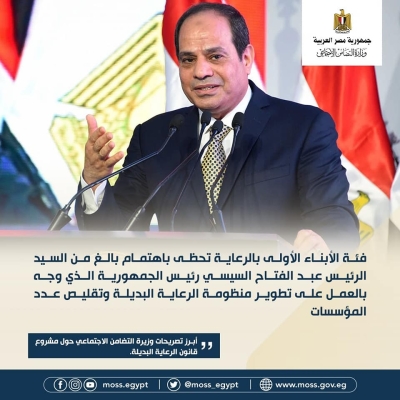
Yasser Badry Under the patronage and presence of Ms. Nevin Al-Qabbaj, Minister of Social Solidarity, the Ministry launched the first community dialogue on the draft alternative care law, in the presence of Mr. Jeremy Hopkins, representative of UNICEF in Egypt, Dr. Talaat Abdel Qawi, President of the General Union of Non-Governmental Associations, more than 22 partner NGOs in the social care sector, representatives of the House of Representatives and the Senate, representatives of Al-Azhar Al-Sharif, and a number of sponsoring families, in addition to representation from the people of Egypt in social care homes. The Minister of Social Solidarity confirmed that the category of children in primary care receives great attention from President Abdel Fattah El-Sisi, President of the Republic, who directed work to develop the alternative care system and reduce the number of institutions, believing that the family environment is the best for raising children in order to ensure the achievement of psychological and emotional stability, in addition to the integration of services provided to them, both from alternative families and from government agencies and all relevant institutions, and therefore the state is moving towards “deinstitutionalization.” Al-Qabbaj added that the Ministry is working hard to crystallize the reform of the alternative care system through several main axes, the first of which was developing a national strategy for alternative care that was launched during the year 2021, and the second of these axes is to find a comprehensive legislative support represented by the preparation of a draft law on alternative care, which was prepared with the participation of some civil society organizations working in this field. The law focuses on finding new alternatives to the alternative care system with the aim of achieving the best interest of children. It also specifies the general framework of this system to ensure that the efforts of actors are organized and their budgets are directed in an integrated manner to serve the achievement of the general objectives of the strategy to make the best use of available resources, whether governmental, private, civil society organizations or the private sector. Al-Qabbaj explained that the draft law was intended to be an umbrella for developing this system, in addition to creating a unified legislative reference for those implementing the alternative care system to rely on, reducing the separation of children from their biological and extended families, and achieving the best interests of the children. The law also highlights children’s entitlement to benefits for beneficiaries of the alternative care system and caregivers to confront all the challenges they face, such as providing adequate housing, decent education, health care, a source of regular monthly expenses, and a job opportunity. The spirit of the law focuses on supporting the Egyptian family entity and early intervention with natural and extended families to deal with family problems before disputes develop to the point of separation or divorce, with the importance of focusing on integrating children with their families, in addition to achieving the integration of the care system and taking into account the gradual introduction of alternative care systems so that family alternative care is at the top of this progression and institutional care is the last line of response. The law also focuses on developing response systems that address every stage of a child’s life and stages of care, starting from birth until the age of 18 years when transitioning to subsequent care, and successively until complete independence after the end of the period of subsequent care. This is in addition to the necessity of transferring the responsibility for supporting the alternative care system from a responsibility at the level of a single ministerial portfolio to a responsibility that falls on the shoulders of all other state ministries, and setting clear texts to regulate cooperation mechanisms with other ministries in all stages of care.